

Project
Website Chatbot
Sign in and ask a question. A small deterministic FAQ layer answers what it can instantly; anything else goes to Amazon Bedrock's Nova Lite model behind a Bedrock Guardrail. Every reply says exactly which path answered it.
Demo
Ask a Question
This runs against a real AWS backend — no mock data. Try asking about this site's cost, source code, or tech stack to see the FAQ layer answer instantly; ask something else and watch it go to Bedrock instead. Try asking for investment advice to see the guardrail step in.
Privacy notice: messages are stored only long enough to redisplay your conversation, and expire automatically after 24 hours via DynamoDB TTL — nothing is kept beyond that.
Signed in as
Architecture
How It Works
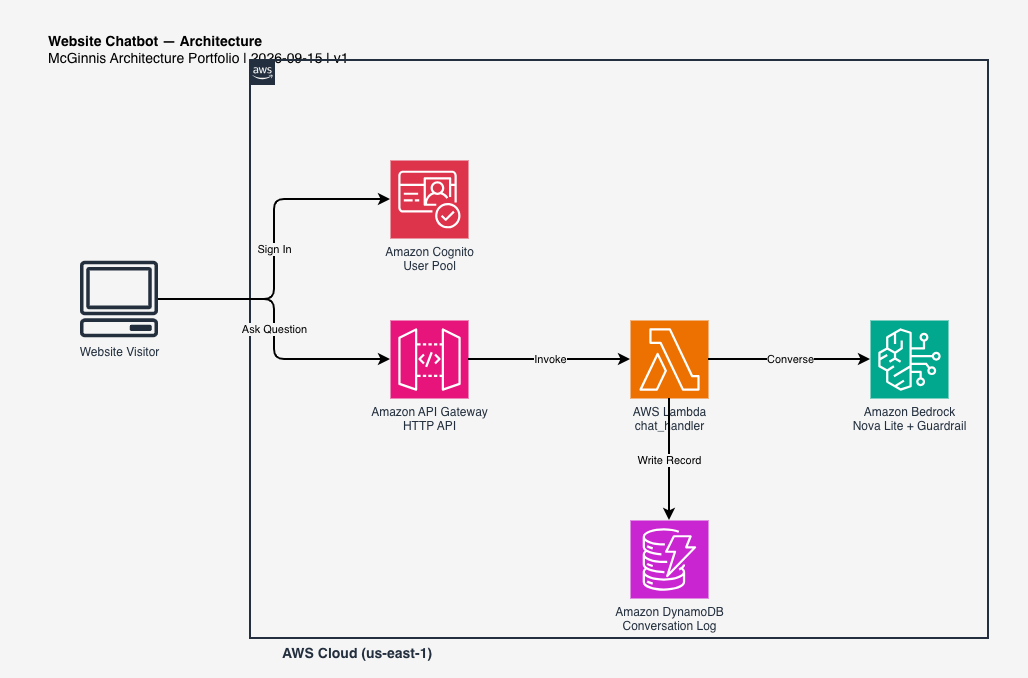
This is a real AWS project, not a mockup. Here's what actually happens between sending a message above and a reply appearing — click any step to jump to it, or let it play through on its own.





-
1
Visitor signs in via Cognito
The browser talks directly to a Cognito user pool's public API to sign up, confirm, log in, or reset a password — no server sits in the middle of authentication.
-
2
Browser sends the message to API Gateway
With a valid Cognito id token attached, the browser calls
POST /chat. API Gateway's JWT authorizer verifies the token before Lambda ever runs — there's no anonymous path into this Lambda at all. -
3
Lambda checks a deterministic FAQ list first
A small keyword-matched list of questions about this site (cost, source code, tech stack, and more) is checked before anything else. A match answers instantly, with zero Bedrock cost.
-
4
Unmatched questions go to Bedrock behind a Guardrail
Only messages the FAQ layer can't answer reach Nova Lite — and every one of those still passes through a Bedrock Guardrail first, which can block a request outright (try asking for investment advice) before the model ever sees it.
-
5
DynamoDB stores the exchange with a 24-hour TTL
Both your message and the reply are written with a
ttlattribute set 24 hours out — DynamoDB deletes the item automatically once that time passes, no cleanup job required.
Use Cases
Where This Pattern Fits
"Deterministic answers first, AI as the fallback" shows up anywhere a support experience wants AI's flexibility without AI cost or unpredictability on every single question.
Product support widgets
Most support questions are the same handful of FAQs — answering those for free and reserving AI for the genuinely novel ones keeps cost proportional to how helpful it actually needs to be.
Internal knowledge-base assistants
A company's most-asked questions (PTO policy, IT setup, etc.) can be answered deterministically, with an AI fallback for everything a static FAQ page never anticipated.
Regulated or safety-sensitive domains
Anywhere certain topics genuinely shouldn't get an AI-generated answer at all — a Guardrail's topic-denial policy blocks the request before the model even sees it, not after.
Pricing
What This Actually Costs
Pay-per-use the whole way through — an unused demo costs nothing. These are estimates based on public AWS list pricing, not a guarantee.
What drives the cost
- Bedrock (Nova Lite + Guardrails) — only invoked for questions the FAQ layer can't answer; billed per token, plus the guardrail's own per-request evaluation cost.
- Cognito — free for up to 50,000 monthly active users.
- DynamoDB — on-demand billing for conversation history; TTL keeps the table small automatically.
- Lambda & API Gateway — billed per request; effectively free at this scale.
Design Decisions
Why I Built It This Way
A few choices here aren't the only way to build this — here's the reasoning behind them.
The browser never talks to Bedrock directly
Every model call happens inside chat_handler.py
— the only thing in this stack holding Bedrock permissions
at all. That keeps the FAQ-first cost control and the
guardrail enforcement both mandatory, not something a
modified client request could route around.
The FAQ layer is genuinely deterministic, not a second AI call
faq.py is plain keyword matching against a
fixed list — no model involved. That's the entire point:
it costs nothing to run, answers instantly, and its
behavior never drifts, unlike asking a model "is this an
FAQ question?" would.
A topic-denial guardrail, not just content filters
Content filters mostly matter for content nobody would responsibly type into a portfolio demo to prove. A denied topic (financial advice) is something anyone can safely and immediately trigger — "what stock should I buy?" — making the guardrail's existence actually demonstrable, not just configured.
DynamoDB TTL instead of a scheduled cleanup job
Expiring conversation history is a better fit for TTL than for a scheduled Lambda job — each item already knows its own expiration the moment it's written, so there's no separate job to schedule, monitor, or fail.
Next Iteration
What I'd Change Next
The gaps I know about: what I'd add before trusting this with real traffic or real data.
A daily spend cap
The chatbot controls cost by answering FAQs first and blocking off-topic questions, but unlike the summarizer it has no daily limit. A DynamoDB counter like the summarizer's would put a hard ceiling on Bedrock spend.
Alarms on Bedrock errors and guardrail hits
A spike in guardrail denials or model errors would be the first sign of abuse or a bad deploy. I'd alarm on both.
Architecture Diagram
Full Architecture Diagram
The complete AWS architecture diagram for this project, built with draw.io. Click it to expand full screen.