

Project
Data Lake & Analytics
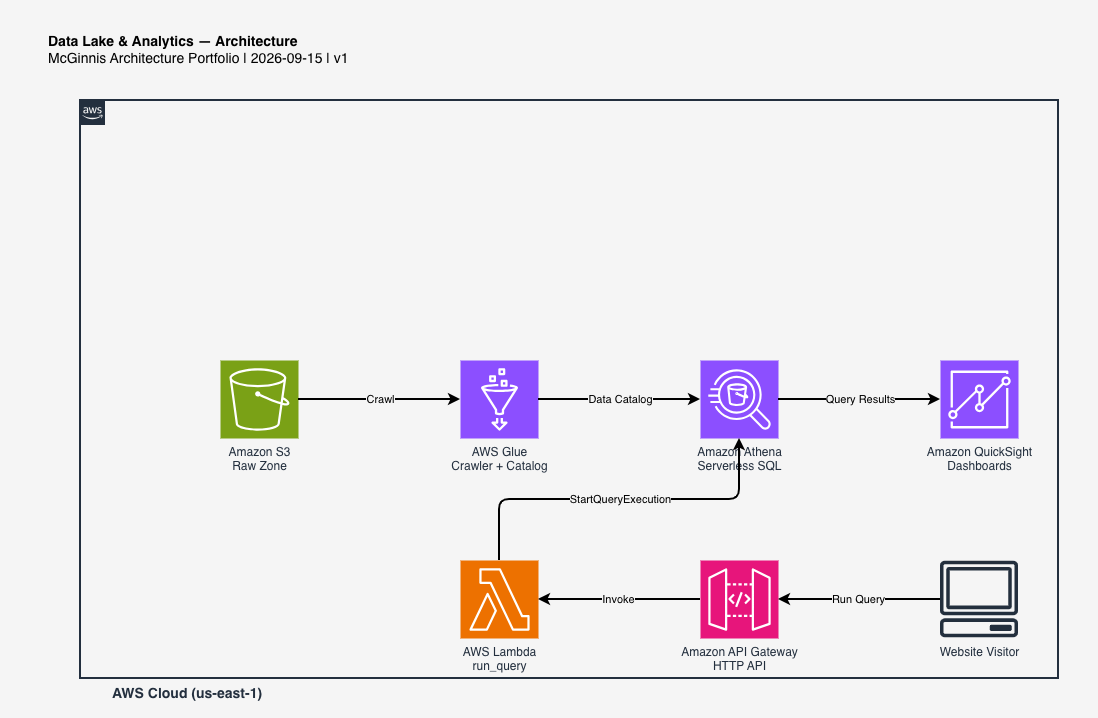
A serverless analytics pattern: an S3 raw zone, crawled by AWS Glue into a Data Catalog, queried with serverless SQL by Amazon Athena, and visualized with Amazon QuickSight.
Demo
Run a Sample Query
This runs entirely in your browser against a small, static dataset baked into this page — no AWS backend, no network requests. Pick a preset query below to see the shape the real Athena-backed version would have.
Your query results will appear here once you run one.
Architecture
How It Works (As Designed, Not As Deployed)
This diagram shows the architecture exactly as documented in this project's CDK stack and design notes — since nothing here is actually running, every step is shown lit up rather than progressing on its own. Click any icon to jump to its written explanation below.



-
1
Source data lands in the S3 raw zone
The raw zone is the single source of truth every downstream service reads from — nothing is transformed or deleted in place.
-
2
A Glue crawler updates the Data Catalog
The crawler inspects the raw zone's objects and keeps a Glue database/table schema up to date, so every query engine downstream shares one schema definition.
-
3
Athena runs serverless SQL against the catalog
A Lambda-fronted API would call
start_query_executionagainst a dedicated workgroup, then poll for results — no cluster to provision, pay only per query. -
4
QuickSight visualizes the results
QuickSight reads directly from Athena's result set — it's account-level and per-seat licensed rather than something the CDK stack provisions itself.
Use Cases
Where This Pattern Fits
A serverless data lake shows up anywhere raw, semi-structured data needs to become queryable without standing up and managing a database or a data warehouse cluster.
Ad-hoc business reporting
Answering a one-off question against raw event or transaction logs without waiting on a data engineering ticket to build a pipeline first.
Log & clickstream analytics
Landing application or clickstream logs straight in S3 and querying them with SQL instead of standing up a dedicated log analytics platform.
Executive dashboards
Feeding QuickSight (or any BI tool that can read Athena results) from a single, consistently cataloged source of truth across teams.
Pricing
What This Would Actually Cost
Nothing here is deployed, so nothing here is billing today — these are estimates based on public AWS list pricing for what the architecture above would cost if it were running.
What drives the cost
- Amazon QuickSight — the dominant cost at small scale: ~$9–24 per author/reader seat per month, billed whether or not anyone opens a dashboard that day.
- Amazon Athena — billed per TB of data scanned per query (~$5/TB); effectively free at a demo's data volume.
- AWS Glue — crawler runs and Data Catalog storage are billed per DPU-hour and per object; small but non-zero if the crawler runs on a schedule.
- S3, Lambda & API Gateway — storage and per-request pricing; effectively free at this scale.
Design Decisions
Why I Designed It This Way
A few choices here aren't the only way to build this — here's the reasoning behind them.
Athena over a provisioned query engine
Redshift or EMR would both work here, but both bill for provisioned capacity whether or not a query is running. Athena's per-query pricing matches this project's actual usage pattern — occasional, ad-hoc — far better.
QuickSight left out of the CDK stack
QuickSight is an account-level subscription with its own per-seat billing rather than a stack-scoped resource — trying to provision it per-project via CDK wouldn't reflect how it's actually adopted in a real organization, so the stack stops at Athena and documents QuickSight as the next layer instead.
A static demo dataset, not a live query interface
A real SQL-input box over a live Athena connection would cost real money per keystroke from anonymous visitors with no guardrails. Three preset "queries" over a small baked-in dataset show the same request/wait/results shape without that exposure.
Next Iteration
What I'd Change Next
The gaps I know about: what I'd add before trusting this with real traffic or real data.
Parquet, partitioned by date
The demo dataset is small and static. A real lake would store columnar, compressed Parquet partitioned by date so Athena scans, and bills for, far less data per query.
Scan limits on the workgroup
If anyone other than me could run queries, I'd set a per-query and daily data-scanned limit on the Athena workgroup so one query couldn't produce a surprise bill.
Architecture Diagram
Full Architecture Diagram
The complete AWS architecture diagram for this project, built with draw.io. Click it to expand full screen.